Wexley, Wiltshire · Casting since 1687
A bell is a chord.
Every bell we cast sounds five notes at once. The founder's work is drawing a shape that lets them agree. The tuner's work is cutting metal until they do.
Five notes, struck once.
Strike a bell and the metal rings in several modes at the same time. Founders tune the lowest five: the hum an octave below, the prime, the tierce a minor third above it, the quint a fifth above, and the nominal an octave up.
The ear takes the nominal and hears a note an octave beneath it. That is the note the bell is named for, and in a well-tuned bell the prime sits exactly there.
The tierce is why a bell sounds the way it does. Switch it off while the tenor is still ringing and the melancholy leaves with it.
The note is decided at the drawing board.
A bell's pitch follows its diameter. Double the width and the note drops an octave. Weight rises with the cube, so the octave costs eight times the bronze.
Everything a tuner does afterwards removes metal from the inside, and removing metal lowers a partial. A bell can be tuned flat and never sharp, so we draw each one a little sharp on purpose.
- Strike note
- G3 196 Hz
- Weight
- 12–2–7 637 kg
- Hum
- 98 Hz octave below
- Nominal
- 392 Hz octave above
Eight bells, and every order they can stand in.
English bells hang on wheels and swing full circle, so each one sounds once in a row and can move only one place between rows. The orders are permutations, and a method is a route through them.
The simplest route is plain hunt. The treble walks from the front of the row to the back and home again in sixteen changes, and every other bell does the same, one step behind. Ring it and follow the two lines.
- 1
Drawing
Every bell begins as a line on paper. The profile is drawn at full size, and a strickle board is cut to match it: a template that sweeps the mould into that exact curve.
- 2
Moulding
The core is built of loam over brick and swept with the strickle. A false bell of clay carries the inscription in wax letters. The cope is built over it and dried, the false bell is broken away, and what remains is a bell-shaped void.
- 3
Casting
Bell metal is about four parts copper to one part tin, melted to 1,100 °C and poured into the buried mould in one unhurried stream. A tenor stays in the ground for a week before it is cool enough to lift.
- 4
Fettling
The mould is broken off and the casting cleaned. The runner is cut away and the lip is dressed. This is the first time anyone hears the bell.
- 5
Tuning
On the vertical lathe, bronze is cut from the inside of the bell a shaving at a time until the five partials agree. Every cut lowers a note. There is no cut that raises one.
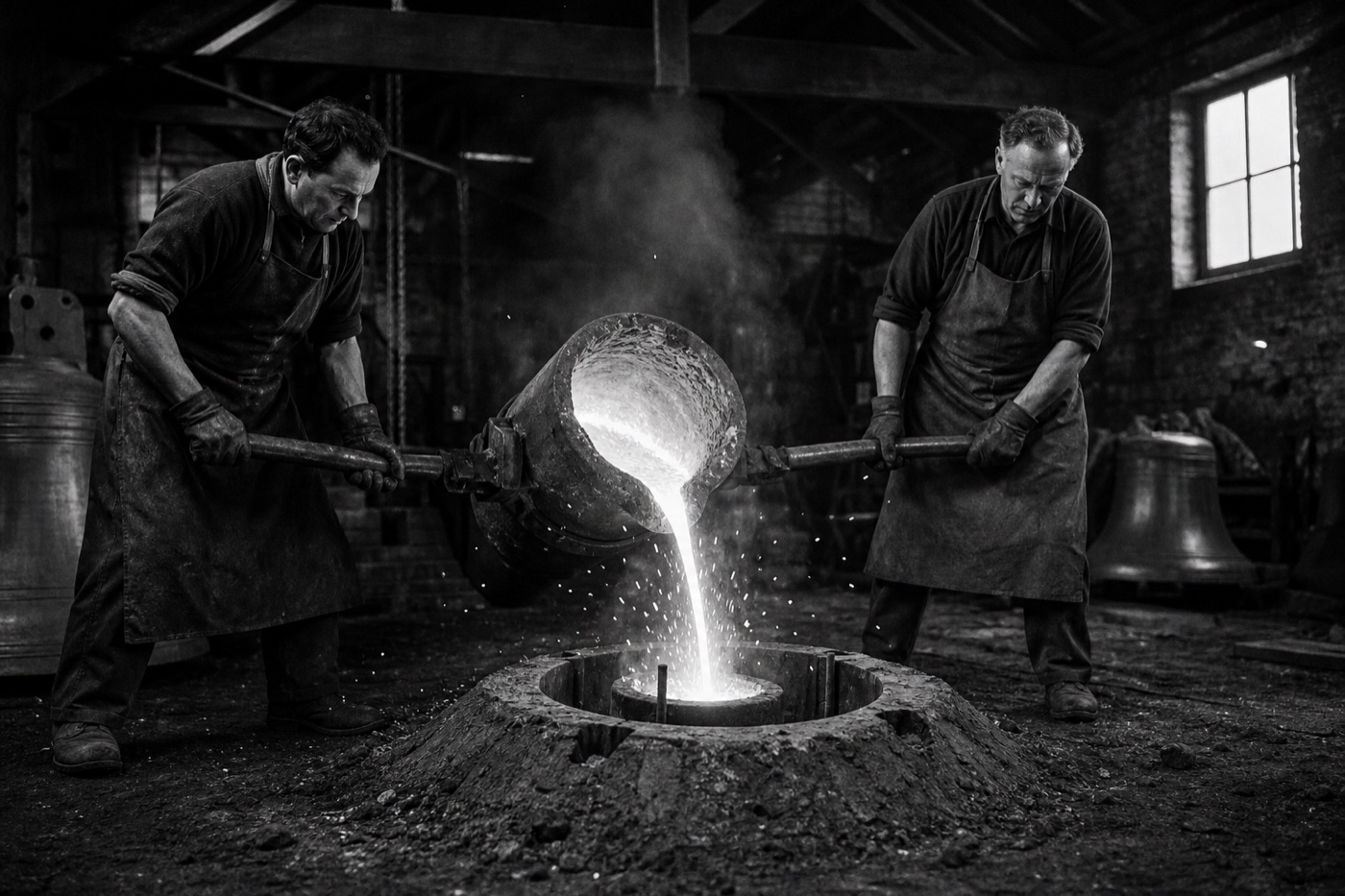
The foundry
We are on Foundry Lane, on the west side of Wexley, ten minutes' walk from the station. Visitors are welcome on Thursday mornings by arrangement. Bring ear defenders if you would like to watch a bell tuned; we keep spares.
Aske & Fell, Bellfounders
Foundry Lane, Wexley, Wiltshire
Hours
- Thursday
- 09.00–12.30, by arrangement
- Pours
- Announced a fortnight ahead
- Tuning
- Most weekdays, ear defenders provided
Colophon
Set in Newsreader and Geist Mono. Every bell on this page is synthesised in the browser from eight partials, each doubled a hair apart, which is where the slow beating comes from. Nothing is recorded. The profiles are one curve, drawn to scale from the diameter. The photograph of the pour was generated and then printed in the foundry's two inks.